What would you do if your best friend turned to you like a deer in headlights, resembling a prisoner about to make a run for it…oh, and she’s wearing a wedding dress, a hundred guests are sitting in a church, and a man is standing in a tuxedo at the altar? Every Great Man beautifully depicts the relationship between two best friends, and the moment fight-or-flight mode is activated, plus so much more.
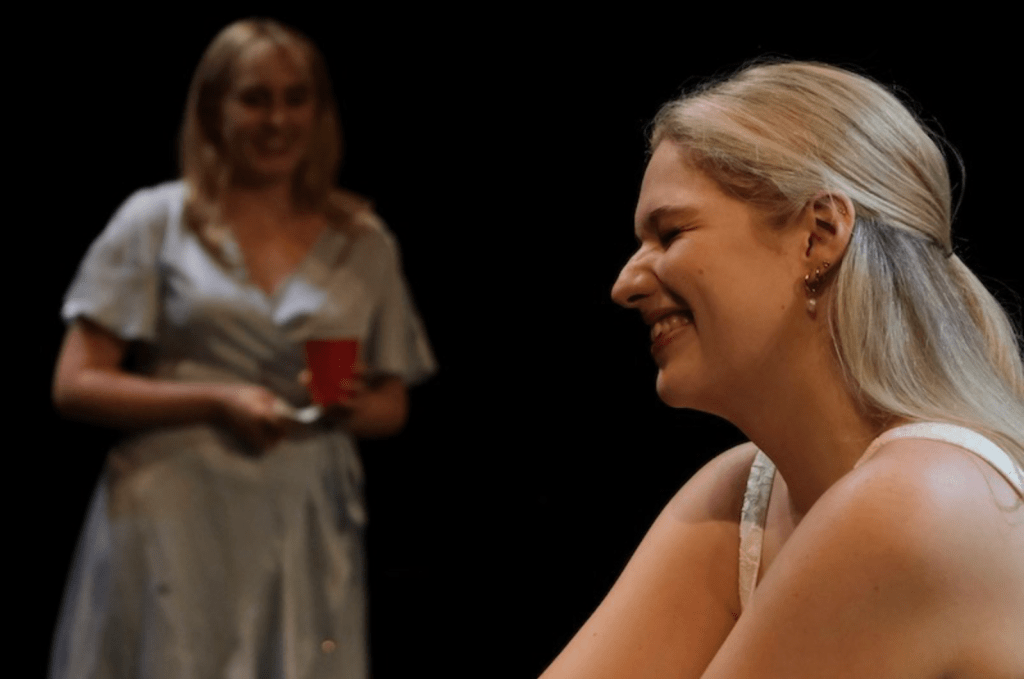
Rachel McKay’s piece opens like a boiling pot of water; the clock’s ticking, the bride’s walking, and with every step we hear the echoes of wedding guests in her head crescendoing as if she’s walking the plank. ‘Many brides get cold feet’; Alex’s best friend Grace (played by Lauren Lewis) reassures her, but this feels less like a ‘spiral’ and more like panic, doubt and utter fear.
The audience hovers in the round as these two best friends attempt to make a decision: does Alex( McKay) walk down that aisle or run? The emergency bag appears: tequila, gin, snacks, sarcasm and quick wit to lighten the mood. At times, McKay’s writing offers moments of predictability, emphasising a stereotype; however, both actors embrace the text by leaning into the cringe and encouraging us to do so too.
McKay takes us back in time to key moments in Alex and Grace’s childhood — the good memories, primary school classes riddled with wonderful innocence. The bad memories, Alex’s experience with grief. Lastly, we see the ugly memories of eating disorders, body image insecurities and inappropriate male relationships. McKay titled this play based on the famous saying ‘behind every great man, there is a great woman’, but perhaps the saying relevant in this case is ‘behind every great woman is her great best friend’.
Lewis captivates with her punch and precise comedic timing, offering us laughter as moments of relief from tension. Grace cares for Alex more than she cares for herself, a true reflection of a female ‘ride or die’ connection. The audience explodes with clarity when a flashback of the girls discussing their crushes occurs, and Alex hints that hers is a female teacher. We understand and sympathise, and we see clearly that the wedding day crisis is more than justified. Alex is trapped between her deepest secret and living a lie.
Alex’s fiancé, Dylan, played by Sam Warren, enters the stage, immediately painting a vivid picture of disrespect for Grace by dismissing her from the room. We understand his frustration and confusion; however, his approach of gaslighting sits uncomfortably within the room. Dylan isn’t evil, but in this moment, his hurt and desperation, not to have wasted seven years dating his high school sweetheart, get the better of him. McKay has precisely described the two different languages spoken by men and women because, whilst Dylan sees begging Alex to marry him as romantic, the audience sees it as dark and sinister. She is uncomfortable, and he is in denial.
Grace and Alex close the show with a happy ending, bringing back that hint of cringe, but it’s approved and warranted through a satisfying ending. Female friendships are cycles of loving, caring, bickering and solving crises. Two best friends will ask no questions, drive the getaway car and bury the body as we see countless times in Every Great Man.
The only true critique is that the title should lean more towards the journey of friendship and less towards the romantic relationship present. McKay nonetheless has written a wonderfully enriching piece of theatre, leaving audiences grateful for their best friends and the moments of crisis they share.
 Wandering and Wondering
Leave a comment